

Trauma-Informed Somatic Therapy: How the Body Holds Experience

In a world that uplifts think-pieces and connection with one’s body only to change it, somatic therapy can bring the balance of embodiment to the forefront. Embodiment is the act of bringing an idea, belief, or thought into your body to be noticed and felt. For traumatized, neurodivergent, and disabled folks, though, this can feel difficult. The difficulty can be because there tends to be a disconnection from our bodies. The therapists at Nido Individual and Family Therapy can safely bring one through exploration and discovery to deepen one’s relationship with their body and understand what feels best for them in times of distress.
What is Somatic Therapy?
According to Harvard Health Publishing, “somatic therapy explores how the body expresses deeply painful experiences [by] applying mind-body healing to aid with trauma recovery (Salamon, 2023).” To employ these techniques we have to acknowledge that our bodies are very intelligent. It is our brains that want to keep us safe and bypass our body’s signals. When your therapist is asking you, “where do you feel that in your body?,” they are utilizing a “bottom up” technique and asking you to drop into your body’s natural intelligence. However, for some, this may not feel safe. If you’ve ever experienced a traumatic event (natural disaster, car accident, violence, etc.), are neurodivergent, or are disabled, dropping into your body will feel foreign.
Window Of Tolerance And Polyvagal Theory
This is because our nervous system has stored a previous negative experience and told our brains not to go there again. We can reference Dr. Stephen Porges’s polyvagal theory to “explain how autonomic regulation shapes the body’s ongoing capacity to maintain stability, support health, and adapt to changing conditions (PVI).” Our nervous system will tell us if we should be relaxed, mobilized, or immobilized in response to outside stimuli. From here, we understand our reaction according to our nervous system’s “window of tolerance.” This concept allows us to understand our nervous system’s capacity, which means: Am I able to handle what threat my body is perceiving at this time?
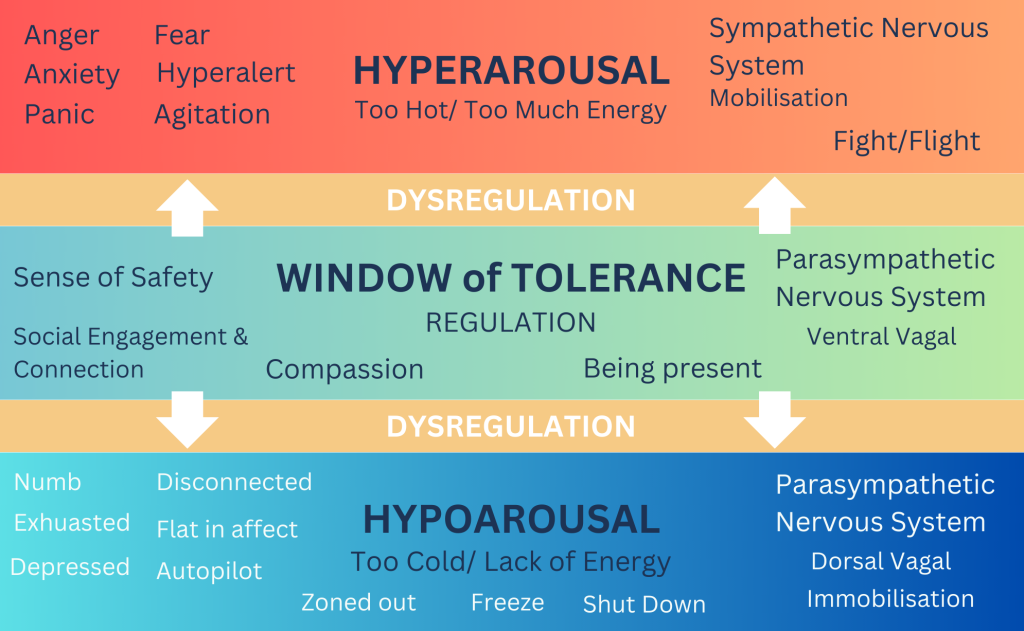
To answer this question, it is best to utilize therapeutic relationships as we can see our body’s reactions show up as depression, anxiety, and other dysfunction. Sitting with a licensed mental health professional can help one to explore deep-seated beliefs and experiences that our heads continue to rationalize and see as definite. A therapist can sit with someone while they work through the past pain and current disconnection. Also, working through these scenarios allows the practice of identifying triggers, bodily responses, and identifying what one’s body needs in order to return to the “window of tolerance” or feeling regulated.
Who Benefits Most From Body-Centered Therapy
Somatic therapy with a trained professional is a positive experience for survivors of trauma, folks who intellectualize their emotions as opposed to feeling them, and self-aware clients who would like to go deeper into their therapeutic work. In addition to having a safe container to feel into their bodies, somatic therapy can attune clients to secure attachment. This is because, according to Fasola (2025), co-regulation, the way that the nervous system of one individual influences the nervous system of another, plays a large part in returning to a safe and healthy baseline once dysregulation is noticed. These dynamics strengthen the relational aspect of therapy as well and serve as a model that clients can take into the world.
Exploring Somatic Therapy at Nido Individual & Family Therapy
Nido therapists utilize body-based or somatic therapy to deepen sessions and relationships with clients. It has proven to be a door to the depth work that all of our team is trained in. If you are looking to begin therapy with a trauma-informed therapist who can integrate somatics in session, reach out to us to book a free 20-minute consultation. All of our therapists will be happy to walk alongside you while you rewire your nervous system for ease instead of danger.
——————————————————————
References:
Fasola, C. (2025, February 6). The Co-Regulation effect — relationship restoration. Relationship Restoration. http://relationshiprestoration.org/blog/the-co-regulation-effect
Fung, L. (2024, June 18). Using the window of tolerance to regulate emotions for effective change in cognitive behavioural therapy -. Your Therapy With Leah. https://yourtherapywithleah.co.uk/window_of_tolerance_and_emotion_regulation/
Salamon, M. (2023, July 7). What is somatic therapy? Harvard Health. https://www.health.harvard.edu/blog/what-is-somatic-therapy-202307072951#:~:text=Somatic%20therapy%20explores%20how%20the,to%20aid%20with%20trauma%20recovery.